The Simpsons, "Scenes from the Class Struggle in Springfield" : A Marxist Critique
The Simpsons, "Scenes from the Class Struggle in Springfield" : A Marxist Critique
By Gabriel Shigeura
The Simpsons episode “Scenes from the Class Struggle in Springfield” supports the disproportionate socio-economic status divisions found in the media that is discussed in
Ott & Mack ‘s “Ideology and Media Representations of Class”. The episode does so by using the two class ideologies, American Dream and Conspicuous Consumption, as well as the media celebrated image known as tokenism. When critiquing this episode I found that from beginning to end, that all three terms can be applied on multiple occasions.
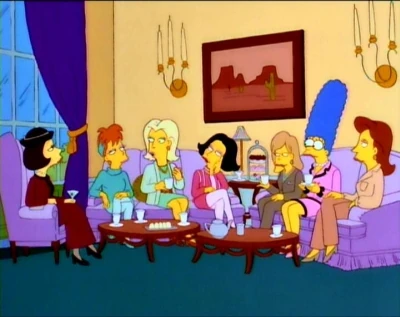
The American Dream is the most prevalent hegemonic ideology in media. It’s defined as the idea that all individuals have the same opportunity to gain any level of success, solely depending on the amount of effort or drive one puts forth in attaining their goal. It is a simple path that promises that it will lead to happiness, but at the same time dismisses the complications of modern life. The American Dream idea refuses to acknowledge issues like social inequality, class struggle, profit-motive, and other life barriers and obstacles towards success. Its purpose is to turn people into compliant workers, rather than elevating status, it instead benefits the capitalist owners. For example, if you notice that Lisa is the one that pushes Marge to buy the outfit. She does not question the reason that Marge is hesitant to buy it in the first place, but instead tells her she needs to treat herself. Marge believes joining the club she can be considered equal to those at the country club. But it’s at the end when the family shows there content to be in a fast food restaurant rather than the club. Not because of the food, but rather they show that they “know their place”.
A token is an individual who reinforces the promise that the American Dream makes, with gaining a higher economic class through personal initiative. The phrase “If I can do it than anyone can.” is phrase to bring the individual to high visibility and attempting to disprove the millions of individuals that work hard and put in the effort, yet were not able to transcend their social class. Marge’s high school friend is not the only character that displays this belief. The golf game between Homer and Mr. Burns reinforces Ott & Mack’s term. But it first shown when Lisa compares Marge to that of Mary Hart, a former Miss South Dakota with no journalism experience, who became a television personality on news shows and later Entertainment Tonight.
Conspicuous consumption has a definition similar to the term “hood rich.” It is the belief that one who purchases material goods and services can be considered a member of the “upper class”. These individuals feel as if they have succeeded in life as a result of owning expensive things. It is a way from someone to conceal themselves from class distinctions. Not realizing that they are comparing themselves to those of the same class, rather than understanding bourgeois wealth. In the very beginning of the episode, with the exception of Marge, The Simpson family was excited to get a new TV, believing they would get a newer and fancier one then before. Another example is the suit that Marge bought. The Chanel suit was already too steep for her price range, but chose to buy it due to the brand name and even justifying it by saying, “it will help the economy”.
Like Wallace, I believe that every ending of The Simpsons episodes, whether they are applying a Marxists critique throughout the show. It's the ending that makes it all go away, because rather than promoting Marx’s theory of class struggle, it instead applies an equation that reinforces Ott & Mack’s terms.
Comments
Post a Comment